
What accounting software really costs in Nigeria, Ghana, Kenya and South Africa: the 2026 price study
Data studyResearchNigeriaGhanaKenyaSouth Africa
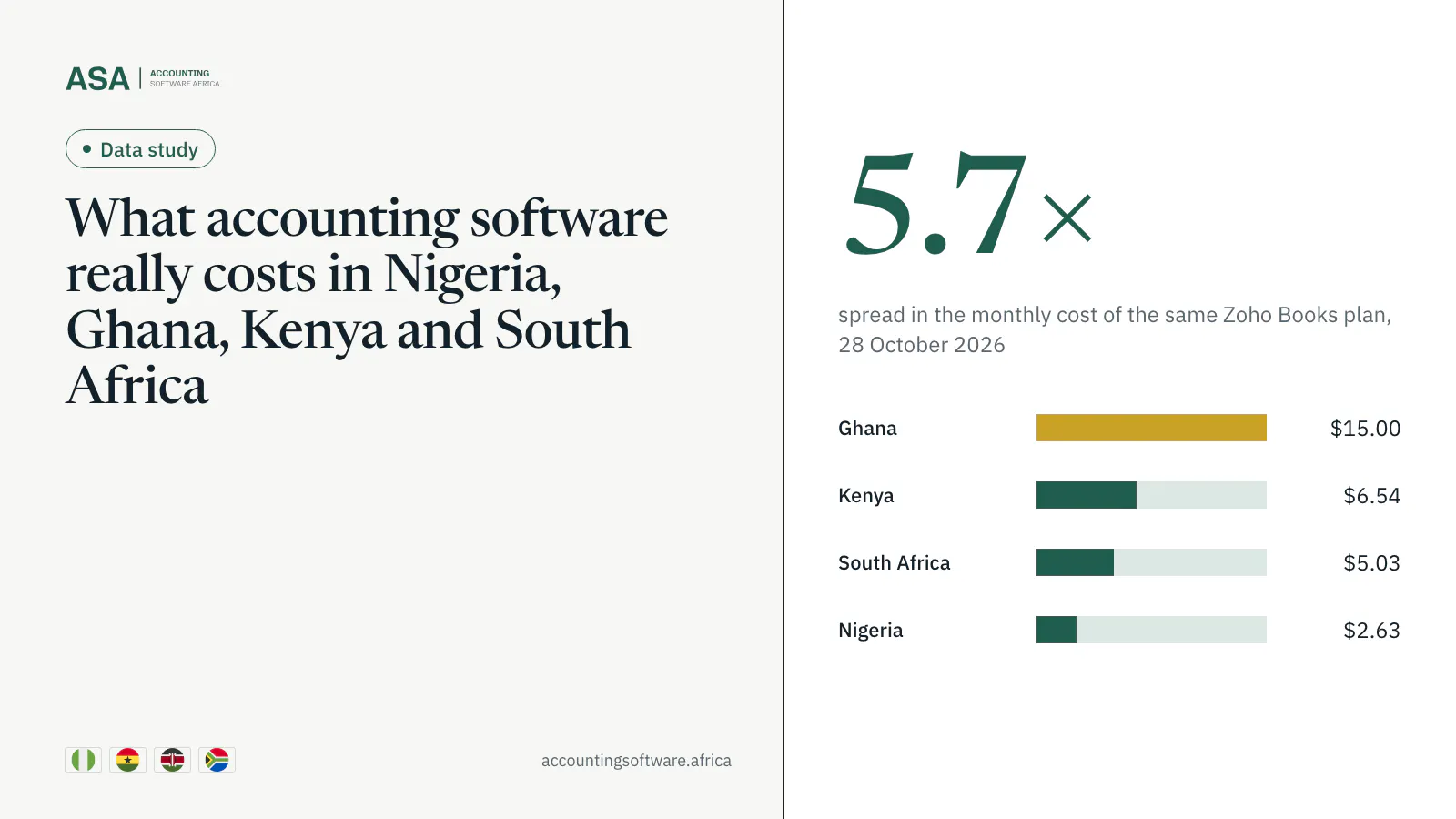
We priced eight accounting products in four currencies using public list prices verified on 28 October 2026. The same plan costs almost six times more in Accra than in Lagos, dollar-billed software costs a five-person Nigerian team up to seventy times more than a naira-priced rival over three years, and Ghana gets no regional discount at all.
Written by Accounting Software Africa editorial Reviewed by Accounting Software Africa editorial
26 Oct 2026 Last updated 28 Oct 2026
The study in numbers
Products priced
8
Cloud ledgers, desktop and ERP
Currencies
4
NGN, GHS, KES, ZAR
Largest regional discount
82.5%
Zoho Books, Nigeria vs USD list
Same-plan spread
5.7×
Zoho Standard, Ghana vs Nigeria
Why did we run this study?
Almost every software comparison read by African accountants quotes prices in US dollars, taken from the vendor's American price page. That is the wrong number for a buyer in Lagos, Accra, Nairobi or Johannesburg in two ways. First, several vendors publish regional prices that are dramatically lower than their US list — and comparison sites rarely show them. Second, dollar-billed products expose the buyer to currency risk that does not appear in the comparison at all.
We wanted one table an accountant could trust: the same products, the same plan level, the same day, in the buyer's own currency, with the source and the rate printed beside every figure.
How did we do it?
- Prices: each vendor's public price page for each country, captured on 28 October 2026. Where a vendor publishes a local-currency price for a country, we used it. Where it does not, we used the US-dollar list.
- Exchange rates: official or mid-market closes for 21–22 October 2026: ₦1,370.64 (CBN NFEM), GH₵11.65 (mid-market), KSh 129.91 (CBK reference) and R16.40 (mid-market) per US dollar.
- Like for like: annual-billing prices where offered, per organisation per month unless the product is priced per user. Excluding VAT unless the vendor publishes VAT-inclusive prices only (Xero South Africa, which we show both ways).
- Excluded: promotions (Xero's and QuickBooks' first-months discounts), reseller discounts, implementation and support fees.
Full details are in our post on how we convert dollar prices to naira and on the methodology page.
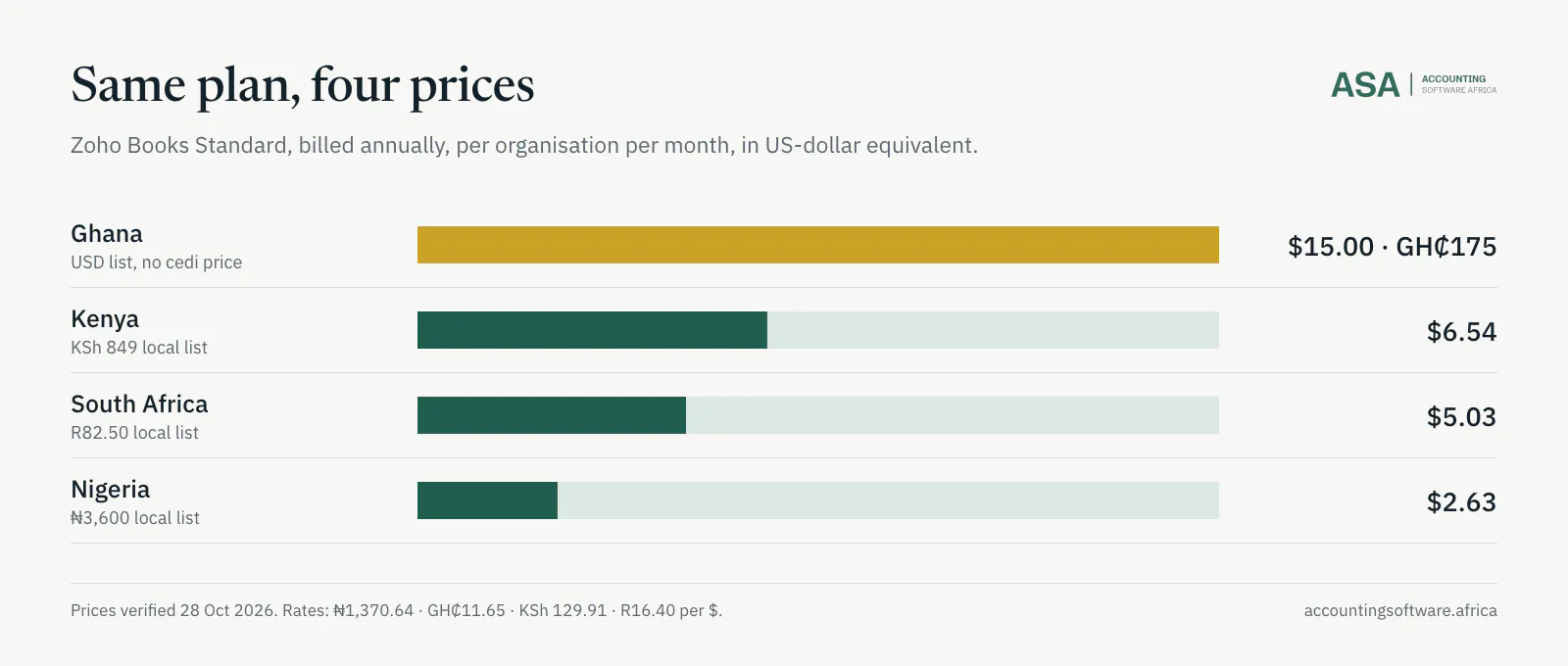
Finding 1: the same plan costs 5.7 times more in Ghana than in Nigeria
Zoho prices Zoho Books by country. Its Standard plan — three users, bank feeds, VAT returns — costs ₦3,600 a month billed annually in Nigeria, R82.50 in South Africa and KSh 849 in Kenya. Zoho does not publish a cedi price, so a Ghanaian buyer pays the US list of $15 — about GH₵175 a month at the card rate.
In dollar terms that is $2.63 in Nigeria, $5.03 in South Africa, $6.54 in Kenya and $15.00 in Ghana. Nigeria pays 17.5% of the list price; Ghana pays all of it.
The reason is purchasing-power pricing. Zoho, like several software firms, sets country prices to reflect local incomes and competition rather than converting a dollar list. Nigeria's discount is the deepest because the naira's 2023–24 devaluation would otherwise have priced the product out of the market. Ghana's absence is harder to explain; Ghanaian buyers we spoke to assumed the dollar price was universal.
Zoho Books Standard by country
| Zoho Books Standard by country | |||
|---|---|---|---|
| Nigeria | ₦3,600 | Monthly | ≈ $2.63 · local NGN list · 17.5% of USD list |
| South Africa | R82.50 | Monthly | ≈ $5.03 · local ZAR list · 33.5% of USD list |
| Kenya | KSh 849 | Monthly | ≈ $6.54 · local KES list · eTIMS included |
| Ghana | ≈ GH₵175 | Monthly | $15.00 · USD list · no local price |
28 Oct 2026 Zoho Books Nigeria pricing (NGN)
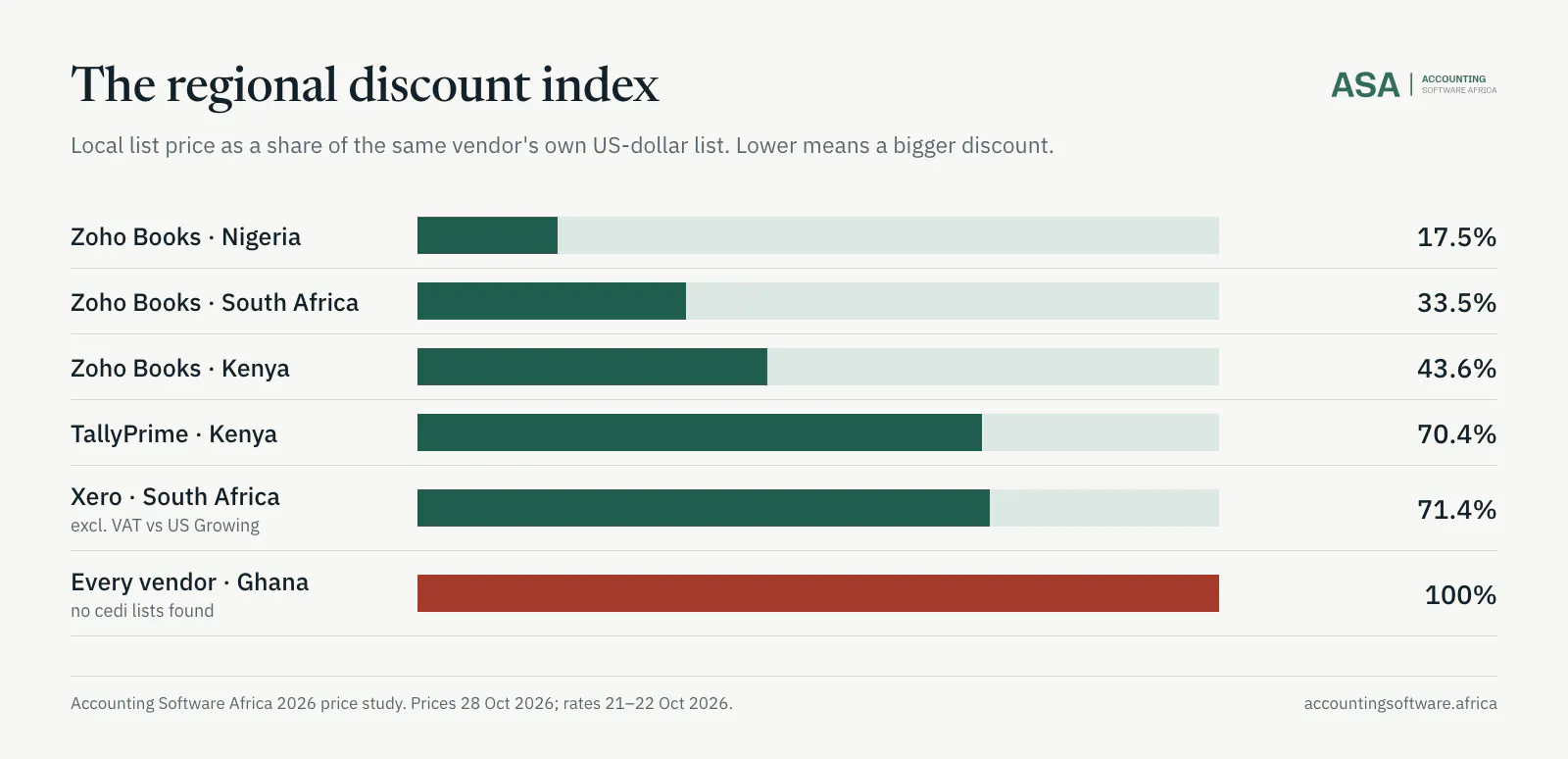
Finding 2: where vendors publish local prices, the discount ranges from 29% to 83%
We built a simple index: the local list price, converted to dollars, as a share of the same vendor's own US-dollar list for the equivalent plan.
- Zoho Books, Nigeria: 17.5% of the USD list.
- Zoho Books, South Africa: 33.5%.
- Zoho Books, Kenya: 43.6%.
- TallyPrime Silver, Kenya: KSh 57,600 for a perpetual single-user licence is about $443 — 70% of Tally's $630 international list.
- Xero Standard, South Africa: R795 a month including VAT is R691 before VAT, or about $42 — 71% of the US Growing plan at $59.
- Every vendor in Ghana: 100%. We found no cedi list for Zoho, Xero, QuickBooks or Business Central.
The pattern is clear: Nigeria and South Africa are treated as markets worth pricing for; Kenya partly; Ghana not at all. For Ghanaian finance teams this is worth raising directly with vendors — and worth factoring into a comparison with locally priced alternatives such as TallyPrime through local partners.
Dollar-billed products, converted to local currency
| Dollar-billed products, converted to local currency | |||
|---|---|---|---|
| QuickBooks Simple Start ($38) | ₦52,084 · GH₵443 · KSh 4,937 · R623 | Monthly | 1 user; Intuit bills Africa in USD |
| QuickBooks Plus ($115) | ₦157,624 · GH₵1,340 · KSh 14,940 · R1,886 | Monthly | 5 users; inventory |
| Xero Growing, US list ($59) | ₦80,868 · GH₵687 · KSh 7,665 | Monthly | South Africa uses its own ZAR list instead |
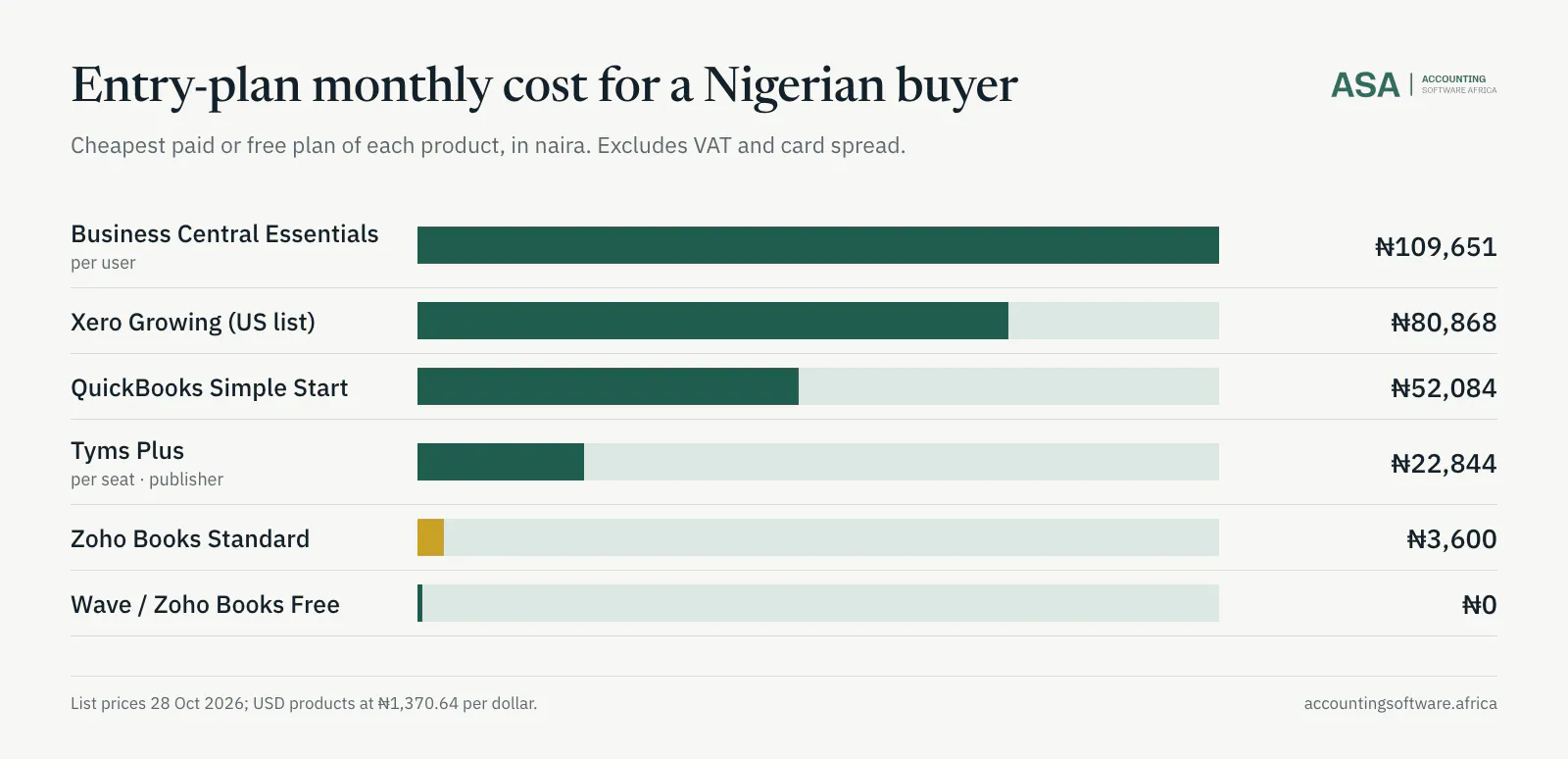
| Business Central Essentials ($80) | ₦109,651 · GH₵932 · KSh 10,393 · R1,312 | Per user per month | Plus partner implementation |
| Tyms Plus ($200/seat/year) | ₦22,844 · GH₵194 · KSh 2,165 · R273 | Monthly equivalent | Publisher's product; billed annually |
28 Oct 2026 QuickBooks Online pricing (USD)
Finding 3: over three years, the choice of vendor matters more than the plan
Monthly prices understate the decision. We modelled the three-year licence cost for a five-person finance team in Nigeria — a typical size for a growing SME with a finance lead, two accountants and two people who raise invoices or approve bills — using each product's cheapest plan that supports five users.
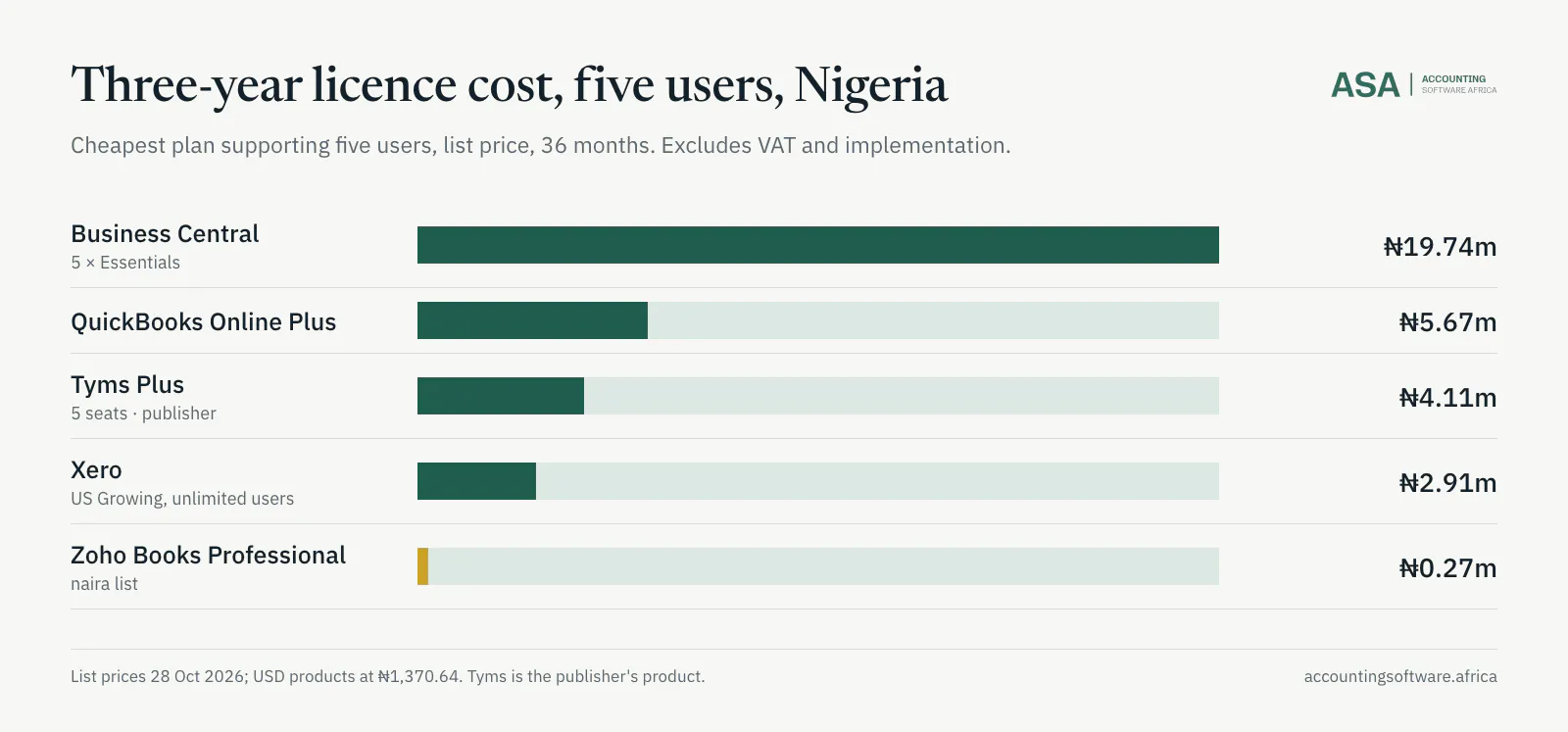
Three-year licence cost for five users
| Nigeria (₦) | South Africa (R) | ||
|---|---|---|---|
| Zoho Books Professional | 273,600 | 5,970 | a |
| Xero (US Growing / ZA Standard excl. VAT) | 2,911,239 | 24,887 | none |
| Tyms Plus (5 seats, publisher) | 4,111,920 | 49,200 | none |
| QuickBooks Online Plus | 5,674,450 | 67,896 | none |
| Business Central Essentials (5 users) | 19,737,216 | 236,160 | none |
The spread is extreme: ₦273,600 against ₦19.7 million for the same team size. Even excluding the ERP, a Nigerian SME choosing QuickBooks Plus pays about twenty times what it would pay for Zoho Books Professional over three years.
That does not make the cheapest product the right one. Business Central is an ERP with manufacturing, warehousing and multi-entity features none of the others match; QuickBooks has the largest accountant network in the world; Xero has unlimited users and the deepest app marketplace. Tyms — the publisher's own product — costs more than Zoho and Xero for a five-person team in this model, and we show it that way. The point is that price differences of this size should be a deliberate trade-off, not something discovered at the first renewal.
Finding 4: dollar billing is a currency bet you did not choose
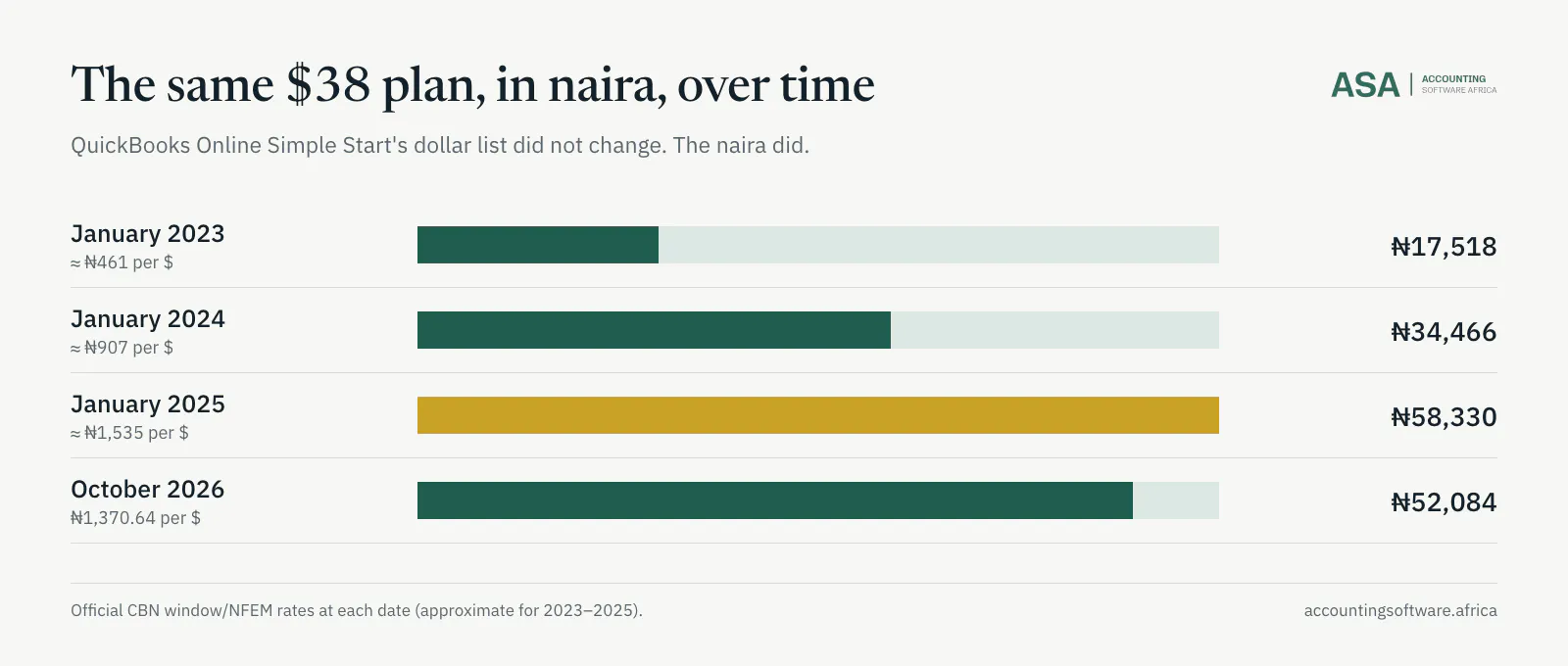
A product billed in dollars has a fixed dollar price and a floating local cost. QuickBooks Simple Start at $38 cost a Nigerian business about ₦17,500 a month in early 2023; at October 2026 rates it is ₦52,084 — roughly three times more, with no change in the dollar list. Kenyan and Ghanaian buyers saw smaller but still painful swings over the same period, and the cedi's 2025 recovery briefly worked the other way.
Products priced in local currency move the currency risk to the vendor. Over the past three years that has been worth more to Nigerian buyers than any feature difference.
What does this mean for buyers in each country?
Nigeria. Check for a naira list before you convert a dollar price. Zoho publishes one; Tyms bills in naira; several Sage and Odoo partners invoice locally. If you choose a dollar product, budget at the official rate plus 10% and pay annually where you can. See our Nigeria buying guide.
Ghana. You pay full dollar prices everywhere we looked. Annual billing protects you from a year of cedi moves, and the gap with locally priced alternatives is wider than in any other market. The Ghana buying guide covers the GRA's E-VAT and the 2026 VAT changes that should shape the shortlist.
Kenya. Local prices from Zoho and Tally come with eTIMS integration included — the real comparison is total cost including any eTIMS connector a dollar product needs. See the Kenya buying guide.
South Africa. Rand lists are normal (Xero, Zoho, Sage); QuickBooks remains dollar-billed. Compare VAT-inclusive and VAT-exclusive prices carefully — Xero shows the former. See the South Africa buying guide.
How to get a better price than the list
Tactics that worked for readers in 2026.
Ask for local-currency invoicing
Vendors and partners with local entities can often bill in naira, shillings or rand even when the website shows dollars.
Buy annually, but only for the core ledger
Annual billing fixes the dollar price for twelve months. Keep add-ons monthly until you know you use them.
Right-size users
Approvers and read-only staff rarely need a full licence. Products with free accountant access or cheap limited users change the maths.
Price the plan you will be on in year two
Multi-currency, inventory and approvals are often one tier up. Price that tier, not the entry plan.
Ignore the promotion
"80% off for three months" saves less than a 10% annual discount over three years. Budget the list price.
Limitations
This is a list-price study. It does not capture negotiated enterprise discounts, partner bundles, or promotions. Prices change: Sage raised South African prices on 1 October 2026, and Microsoft's late-2025 Business Central increase is still working through African renewals — see our Business Central renewals post. Some vendor pages show different prices depending on the visitor's location; we captured each regional page directly. FX rates move daily; each converted figure is only as current as its stated date.
Tyms Inc. publishes this site and makes Tyms. We include Tyms at its public list price because leaving it out would look worse than including it. It does not top any ranking in this study.
Can I use this data?
Yes. Cite "Accounting Software Africa, 2026 price study (verified 28 October 2026)" with a link to this page. Every price links to its source on the relevant vendor profile. If you find a price that has changed, tell us and we will re-verify and re-date it.
Country deep-dive: Nigeria
Nigeria is the most price-sensitive market we cover and, thanks to Zoho's regional pricing and naira-billing local products, the one where buyers have the widest spread of choices. The entry plans range from free (Wave, Zoho Books Free) through ₦3,600 a month (Zoho Books Standard) to more than ₦50,000 a month (QuickBooks Simple Start) — for products that, at the entry level, do broadly similar work.
The naira's path also changes how buyers should read older comparisons. Any article written before mid-2023 that quoted QuickBooks or Xero "in naira" used a rate around a third of today's. If you inherited a software budget from 2023, it is almost certainly wrong.
Country deep-dive: Ghana
Ghana is the outlier. We found no cedi list from any of the major cloud vendors, so a Ghanaian SME pays the US list plus its bank's spread — typically 1–3% above the mid-market rate — and in some cases a foreign-transaction fee. The cedi's recovery in 2025 softened the blow for annual subscribers who renewed during the rally. Local partners selling TallyPrime and ERP products sometimes quote in cedis, which removes the currency exposure, though not the dollar-linked list price behind it.
Country deep-dive: Kenya
Kenya sits in the middle. Zoho's shilling list and Tally's local price give meaningful discounts, and both bundle eTIMS integration — which matters because a dollar-billed product usually needs a separate eTIMS connector. The fair comparison in Kenya is therefore the total of licence plus connector plus any per-invoice fee. On that basis, Zoho Books and TallyPrime are cheaper than their headline prices suggest relative to QuickBooks and Xero.
Country deep-dive: South Africa
South Africa is the most mature market and the most transparent: Xero, Zoho and Sage all publish rand prices, and bank feeds are standard. The traps are smaller: Xero's prices include VAT while Zoho's do not, Sage changed its prices on 1 October 2026, and QuickBooks remains dollar-billed. A like-for-like comparison needs VAT stripped out and the plan with multi-currency (if you need it) priced, because that is where Xero's Premium tier makes a large step.
What did we price, and why these products?
We chose products that appear most often on African shortlists in our reader questions and in local partner networks: three global cloud ledgers (QuickBooks Online, Xero, Zoho Books), one free option (Wave), one perpetual-licence product (TallyPrime), one locally built cloud product (Tyms, the publisher's), and the ERP most often quoted to growing African companies (Business Central). Sage, Odoo, SAP Business One and NetSuite are covered on their profiles but excluded from cross-country tables because they are partner-priced and quotes vary by scope.
What do list prices leave out?
List prices are the visible part of the cost. In the three-year totals above, five items are missing that readers should add for their own case:
- VAT. Nigeria 7.5%, Ghana 20% under Act 1151, Kenya 16%, South Africa 15% — recoverable for registered businesses where the subscription relates to taxable supplies, a real cost for those that are not.
- Card and bank spreads on dollar-billed products: typically 1–3%, sometimes more on naira cards.
- Add-ons. Payroll, inventory, e-invoicing connectors, extra users, advanced reporting and bank-feed aggregators are often priced separately.
- Implementation and migration. Negligible for a cloud ledger set up by your accountant; the largest single cost for an ERP.
- The cost of switching later. Moving ledgers after three years of history costs weeks of finance-team time. A cheap product that will be outgrown in eighteen months is not cheap.
What do prices tell us about vendor commitment?
A local price list is a signal as well as a saving. It usually means the vendor has a local entity or a serious partner network, local payment methods, and someone accountable for the market. Zoho's regional lists in Nigeria, Kenya and South Africa came with localised tax features (eTIMS in Kenya, for example); Xero's rand pricing sits alongside a South African team and bank-feed partnerships. Dollar-only pricing does not mean a product is unsuitable — QuickBooks and Xero are used successfully across all four markets — but it does mean the buyer carries more risk, and that local compliance often comes from third parties.
How often will we update this study?
Every six months, and whenever a vendor changes regional pricing. Each update will be dated, with the previous figures kept in a changelog on this page so readers can see trends rather than just snapshots. If you are a vendor and believe a figure is wrong, send a dated link to your public price page and we will re-verify.
Frequently asked
How much does QuickBooks cost in Nigeria?
QuickBooks Online is billed in US dollars in Nigeria. At ₦1,370.64 per dollar (21 October 2026), Simple Start at $38 a month is about ₦52,084 and Plus at $115 is about ₦157,624, before VAT and card spreads.
Is Zoho Books cheaper in Nigeria than in other countries?
Yes. Zoho's Nigerian Standard plan is ₦3,600 a month billed annually — about $2.63, or 17.5% of the US list. In Ghana there is no local price, so buyers pay the $15 US list.
Which accounting software is priced in rand?
Xero, Zoho Books and Sage publish rand prices for South Africa. QuickBooks bills South African customers in US dollars.
Why is accounting software more expensive in Ghana?
None of the major cloud ledgers we checked publishes a cedi price, so Ghanaian buyers pay full US-dollar lists converted at their bank's rate, without the regional discounts offered in Nigeria, Kenya and South Africa.
Priced per seat, billed in your currency
Tyms bills in 14 currencies including naira and rand. In this study it is cheaper than QuickBooks and Business Central but dearer than Zoho Books and Xero for a five-user team — check whether its features justify the difference for you.
Country hubs
- Nigeria
Naira prices and profiles.
- Ghana
Cedi prices and profiles.
- Kenya
Shilling prices and eTIMS.
- South Africa
Rand prices and payroll.
Sources
- Zoho Books Nigeria pricing (NGN) 28 Oct 2026
- Zoho Books Kenya pricing (KES) 28 Oct 2026
- Zoho Books South Africa pricing (ZAR) 28 Oct 2026
- Zoho Books USD pricing 28 Oct 2026
- Xero South Africa pricing 28 Oct 2026
- Xero US pricing 28 Oct 2026
- QuickBooks Online pricing (USD) 28 Oct 2026
- Tally Solutions — buy TallyPrime (Africa) 28 Oct 2026
- Tyms pricing 28 Oct 2026
- Microsoft — Dynamics 365 Business Central pricing 28 Oct 2026
- CBN official rate history (Monierate) 28 Oct 2026
- Central Bank of Kenya — exchange rates 28 Oct 2026
- South African Reserve Bank — current market rates 28 Oct 2026
- Bank of Ghana — interbank FX rates 28 Oct 2026
Guides
Sources
- Zoho Books Nigeria pricing (NGN) Accessed on 28 Oct 2026
- Zoho Books Kenya pricing (KES) Accessed on 28 Oct 2026
- Zoho Books South Africa pricing (ZAR) Accessed on 28 Oct 2026
- Zoho Books USD pricing Accessed on 28 Oct 2026
- Xero South Africa pricing Accessed on 28 Oct 2026
- Xero US pricing Accessed on 28 Oct 2026
- QuickBooks Online pricing (USD) Accessed on 28 Oct 2026
- Tally Solutions — buy TallyPrime (Africa) Accessed on 28 Oct 2026
- Tyms pricing Accessed on 28 Oct 2026
- Microsoft — Dynamics 365 Business Central pricing Accessed on 28 Oct 2026
- CBN official rate history (Monierate) Accessed on 28 Oct 2026
- Central Bank of Kenya — exchange rates Accessed on 28 Oct 2026
- South African Reserve Bank — current market rates Accessed on 28 Oct 2026
- Bank of Ghana — interbank FX rates Accessed on 28 Oct 2026